Conservation social scientistBangkok, UTC+7PhD candidate, CU Boulder
Tyler Nuckols
Social safeguards, FPIC, GEDSI, and MEL for conservation programs in Southeast Asia.
Open to a full-time role now. Short-term and part-time consultancies, remote or in Thailand.

- 248households surveyed beside Kuiburi National Park, plus 40 interviews
- $415kUSFWS funding: reporting and second‑cycle fundraising
- 7funders written for: USFWS, Darwin, UK PACT, GIZ, CFLI, UNDP, SWITCH‑Asia
- 10 yrin conservation and development, Southeast Asia and North America
- 6peer‑reviewed manuscripts: two published, four under review
- 7awards: two for teaching at CU Boulder, five for research
- Standards
- Used in practice: IFC Performance Standards, World Bank ESF, CMP Open StandardsStudied: GCF safeguards; UN-REDD (Cancun safeguards, SIS, ART-TREES 3.0)
- Languages
- English (native); Thai (conversational, with field research proficiency)
Where I have worked
-
Oct 2025 to Jun 2026Kanchanaburi, Thailand
ZSL Thailand
Consultant, Social Safeguards and Sustainable Agriculture (part-time)
I led implementation of ZSL's FAIRER-GEDSI framework across its Darwin Initiative human-elephant coexistence program, designed the program's FPIC and grievance procedures under IFC Performance Standards and the World Bank ESF, and wrote its agroforestry and safeguards work plan.
More
The program works with farming communities in the buffer zones of protected areas in Kanchanaburi. The FAIRER-GEDSI work covered staff training, protocols, vulnerability mapping, benefit-sharing design, and a bilingual baseline survey of 369 farmers in 17 buffer-zone communities with disaggregated indicators (A-WEAI).
I was lead drafter of the EUR 2.5M SWITCH-Asia concept note (shade-grown coffee and cacao for human-elephant coexistence; ZSL with Kasetsart University and Raks Thai Foundation; submitted December 2025) and co-authored a UK PACT synthesis report on gender equality and social inclusion in Thai agriculture and aquaculture.
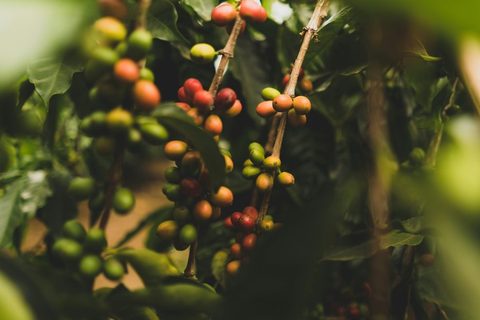
Shade-grown coffee in an agroforestry plot, Kanchanaburi. -
Dec 2022 to Dec 2025Kuiburi, Prachuap Khiri Khan, Thailand
Bring the Elephant Home
Research and Programs Manager
I built the organization's monitoring, evaluation, and learning system under the CMP Open Standards and ran three years of research with farming households beside Kuiburi National Park: 40 semi-structured interviews, a 248-household survey, and a camera-trap study across 20 farm sites.
More
I ran the MEAL system through quarterly adaptive management reviews with staff, community members, and Department of National Parks officials. When early survey data showed the lemongrass livelihood project was missing the households hit hardest by crop raiding, I restructured the targeting criteria before the next cycle.
Bring the Elephant Home was the Thailand partner on a USFWS Asian Elephant Conservation Fund project led by Trunks & Leaves. I prepared the quarterly funder reports and second-cycle fundraising for the Thailand component (USD 191,810 for 2022 to 2024; USD 223,490 for 2024 to 2027) and led its qualitative research component with Akaraphum Pisanwanich. I was principal investigator on a beehive-fence elephant deterrent trial and supervised two research assistants.
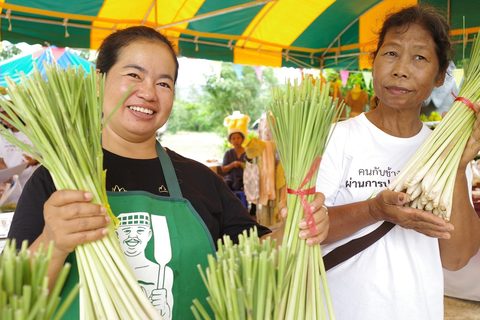
Lemongrass from the livelihood project at market, Kuiburi. -
2022 to 2023Boulder, Colorado
The Nature Conservancy and CU Boulder
Graduate Research Assistant, Climate Adaptation, Equity and Evaluation
A study of the equity of flood buyout programs in New York State. I conducted and transcribed interviews and did the qualitative coding, and I am a co-author on the two papers that came out of it (PLOS Climate 2024, open access; Global Environmental Change 2024).
Flood buyouts, New York State. -
Jan 2016 to Feb 2018Mondulkiri, Cambodia
Elephant Valley Project
Ecotourism, Communications and Livelihoods Manager
The Elephant Valley Project runs a responsible tourism center and community livelihood projects with Bunong communities in Mondulkiri. I managed the center's operations, budgeting, staff, and marketing, ran the livelihood projects, and built the fundraising database and donor communications.
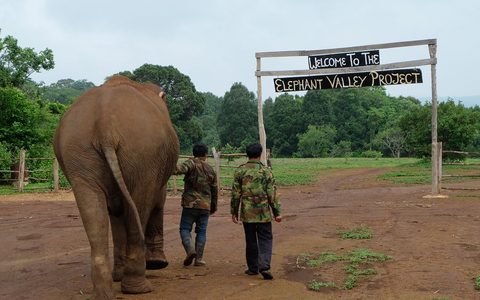
Elephant Valley Project, Mondulkiri. -
2018 to 2021Colorado
Earlier
- Feb to Aug 2021The Wilderness Society, Denver: Digital Organizer and Content Producer (consultancy)
- Aug 2019 to Feb 2021Colorado State University, Office of the Vice President for Research: Project Manager, Global Mapping and Strategic Outreach
- Apr 2018 to Aug 2019Conservation Colorado, Denver: Digital Communications Coordinator
Who sets the terms of living with elephants?
My dissertation (University of Colorado Boulder; fieldwork 2022 to 2025) asks who sets the terms of living with elephants at Kuiburi. It ran inside the Bring the Elephant Home program: the interviews, the Ruam Thai survey, and the camera-trap study are its data, alongside an agent-based model of the Kuiburi conflict system and 11,895 Department of National Parks incident records.
The work names two mechanisms. Imposed coexistence: residents accommodate wildlife under terms they have limited authority to negotiate. Production-first sequencing: the risk-transfer mechanism by which an alternative livelihood project passes its proof-of-concept risk to the participating households.
- 40semi‑structured interviews; 1,684 coded passages
- 248households surveyed, Ruam Thai, November 2024
- 325camera‑trap nights, 20 farm sites, 40 roll‑pole units, no losses
- 11,895DNP elephant incident records, 2020 to 2023
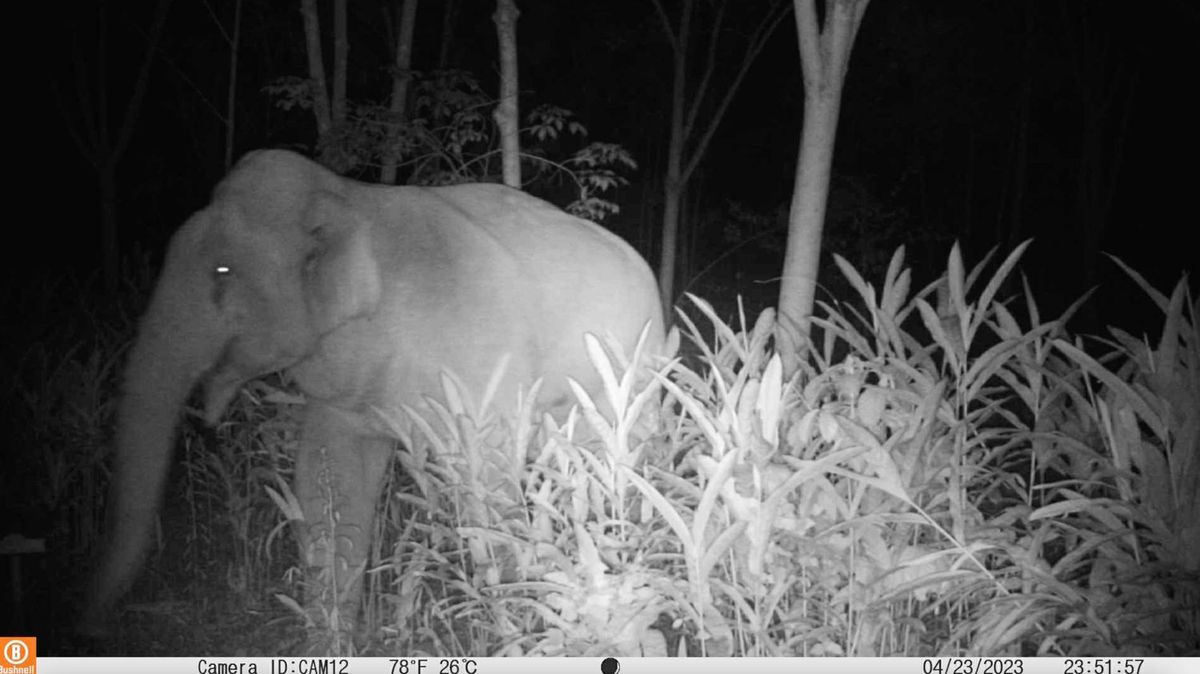
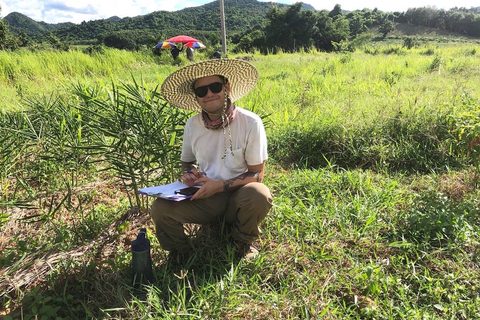
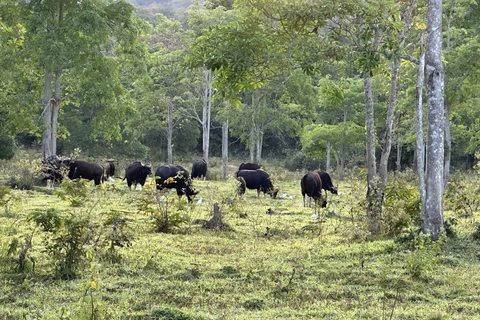
Field data collection beside Kuiburi National Park. 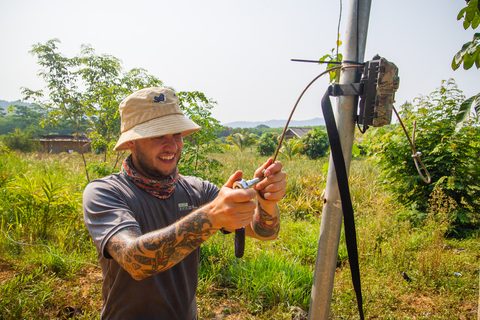
Mounting a camera trap on a roll-pole in a pineapple field. 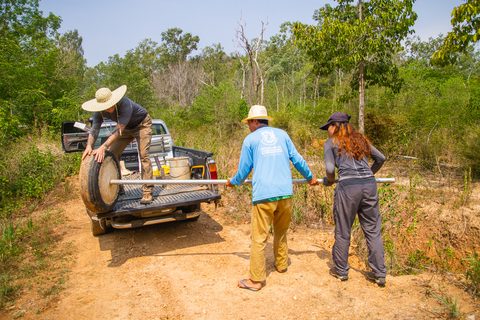
Carrying a roll-pole to a farm site, Kuiburi.
Boundaries: Natural Earth. Park: OpenStreetMap contributors (ODbL).
9,875 timed records of 11,895 Department of National Parks elephant events, Kuiburi, 2020 to 2023. Most happen between 19:00 and 23:00.
Publications and talks
Published
- Walker, S.E., Bennett, N., Smith, E.A., Nuckols, T., Narayana, A., Lee, J., & Bailey, K.M. (2024). Unintended consequences of nature-based solutions: Social equity and flood buyouts. PLOS Climate 3(7), e0000328. doi.org/10.1371/journal.pclm.0000328Published
- Walker, S.E., Smith, E.A., Bennett, N., Bannister, E., Narayana, A., Nuckols, T., Pineda Velez, K., Wrigley, J., & Bailey, K.M. (2024). Defining and conceptualizing equity and justice in climate adaptation. Global Environmental Change 87, 102885. doi.org/10.1016/j.gloenvcha.2024.102885Published
- Nuckols, T. (2020). Plans to prevent future pandemics must consider gender issues, too. Mongabay, 6 May 2020.Commentary
Under review or in revision
- Nuckols, T., Pisanwanich, A., van de Water, A., English, M., & Bailey, K. Imposed coexistence: A multidimensional environmental justice analysis of human-elephant conflict in Kuiburi, Thailand. People and Nature.Under review
- Nuckols, T., Pisanwanich, A., Owen, A., van de Water, A., English, M., de Silva, S., & Bailey, K. The roll-pole: A freestanding camera trap mount for megafauna monitoring in active agricultural fields. Wildlife Society Bulletin.In revision
- Crouthers, R., & Nuckols, T. Environmental justice considerations in human-elephant conflict and coexistence. In IUCN SSC Asian Elephant Specialist Group & IUCN SSC Human-Wildlife Conflict and Coexistence Specialist Group, Guidelines for Human-Elephant Conflict in Asia.Submitted
- van de Water, A., et al. (Nuckols, T., co-author). Pluralism, not polarity: Conservation philosophies within human-elephant landscapes. npj Biodiversity.In revision
In preparation (2)
- Nuckols, T., Pisanwanich, A., Timtang, K., van de Water, A., & Bailey, K. Production-first sequencing (working title): risk transfer in an alternative livelihood intervention at Kuiburi.In preparation
- Nuckols, T., Pisanwanich, A., & Bailey, K. Exposure and structural disadvantage as distinct axes of household experience of human-elephant conflict in Kuiburi, Thailand (248-household survey, November 2024).In preparation
Talks (5)
- Imposed coexistence: Who sets the terms of living with elephants at Kuiburi, Thailand. Invited talk, symposium convened by the IUCN SSC Behaviour Change Task Force, 2nd International Conference on Human-Wildlife Conflict and Coexistence, Bangkok.2 to 4 Mar 2027
- What is "fair" in human-elephant conflict? Understanding local community experiences, monitoring mitigation, and finding solutions through environmental justice. Oral presentation, 32nd International Congress for Conservation Biology, Brisbane.Jun 2025
- Just coexistence? Navigating human-elephant interactions in Kuiburi, Thailand, through environmental justice. SCB Social Science Working Group Conference (virtual).Nov 2024
- Human-elephant coexistence: Environmental justice in Kuiburi, Thailand. Pathways Europe 2024, Córdoba, Spain.Oct 2024
- Systems of change: Human-elephant experiences in dynamic agroecosystems. 19th International Elephant Conservation and Research Symposium, Chiang Mai.Nov 2023
Research awards (5)
- Beverly Sears Graduate Research Award, University of Colorado Boulder2025
- Graduate Student Research Award, Society for Conservation Biology2023
- CARTSS Graduate Research Award, University of Colorado Boulder2023
- IDEAwild Tools for Conservation Grant2021
- Cynthia H. Schultz Research Award2021
References are available on request.
Degrees
- 2021 to present PhD, Environmental Studies University of Colorado Boulder. Dissertation: Environmental Justice, Resilience, and Vulnerability in Human-Wildlife Conflict. Advisor Karen Bailey. Defense expected May 2027.
- 2021 MS, Global Conservation Leadership Colorado State University
- 2014 BS, Recreation, Park, and Tourism Sciences Texas A&M University
Registration and certificates
- Current Registered foreign researcher National Research Council of Thailand
- 2023 Certificate in College Teaching University of Colorado Boulder
- 2021 Open Standards for the Practice of Conservation The Nature Conservancy
What I teach
Instructor of record (asynchronous, online) for ENVS 3102 Human-Wildlife Interactions and ENVS 3034 Environmental Justice in Conservation at CU Boulder since August 2023; teaching assistant on ENVS 1000 from 2021 to 2023. CU Boulder gave me the Excellence in Teaching Award and the Best Should Teach Award in 2023.
I designed Environmental Justice in Conservation: From Principles to Practice, an online, self-paced course at the Center for Wildlife Studies. The course page carries the enrollment dates.
I designed a seven-week Thailand field program for Wildlands Studies (four national parks, two UNESCO World Heritage sites).
Ground Truth Advisory
 The name I contract under
I take short-term and part-time consultancies as an individual, contracting under the name Ground Truth Advisory. The work I take on:
- FPIC process design
- Grievance redress mechanisms
- GEDSI analysis
- Safeguards review of proposals and project documents
- Monitoring and evaluation frameworks
I work in the standards I have used in practice (IFC Performance Standards, the World Bank ESF, the CMP Open Standards) and have studied GCF safeguards and the UN-REDD safeguards requirements (Cancun safeguards, safeguard information systems, ART-TREES 3.0). Send me the terms of reference and I will tell you whether it is work I can do well.
Rates on request. I work from Bangkok (UTC+7), remotely or with travel in Thailand. For an example of the comparison work, see FPIC requirements across the biodiversity credit market.
Ground Truth Tyler, on Substack
Writing Grants in a Contracting World
The funding environment for conservation has contracted sharply. How to build proposals that still compete when the pool is smaller and the scrutiny is tighter.
The Alphabet Soup of Monitoring and Evaluation
M&E, MEL, MEAL, MERL: the acronyms keep multiplying but the practice often stays the same. A field guide to what each one means, where adaptive management fits in, and why the real problem is governance, not terminology.
Why Conservation Safeguards Fail
The documents are well-designed. The outcomes for communities are poor. Five structural reasons conservation safeguards fail to translate from paper to practice.
FPIC Requirements Across the Biodiversity Credit Market: A Practical Comparison
Verra SD VISta, CCB Standards, and the Biodiversity Credit Alliance Principles all require FPIC, but their specific requirements differ in ways that affect how you design your consent process. A side-by-side comparison.
Get in touch
For a role, a consultancy, or a question about the research. Send terms of reference if you have them.
tyler@gtadv.org
linkedin.com/in/tyler-nuckols
researchgate.net/profile/Tyler-Nuckols
Bangkok, Thailand (UTC+7)